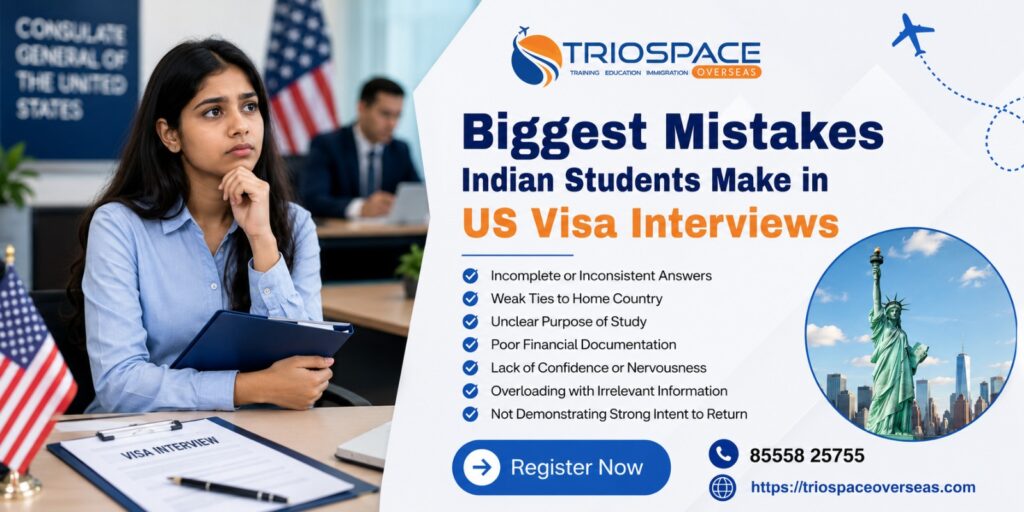
It is quite an accomplishment to get admission in an American university; however, obtaining your F-1 student visa is the last step towards getting started on your education. Each year thousands of Indian students appear for US visa interviews, yet not all make it through owing to some very easy mistakes made by them.
The US visa interview process is certainly not made to play a trick on you. For Indian students who want to pursue higher education in the United States, knowing about these mistakes will definitely be helpful for them. They may even consult experts of US study consultants in Hyderabad.
Why the US Visa Interview Is Important
The visa interview does not take long; it only takes a few minutes. In those few minutes, the visa officer examines you on:
Academic background
University/program choice
Finances
English language abilities
Future career prospects
Intention to go back to their home country upon completing their studies
Students who have good academic backgrounds may still be denied a visa for not being convincing or giving conflicting answers.
1. Memorizing Answers Instead of Speaking Naturally
The worst mistake made by the candidates is memorization of the answers given in YouTube tutorials or coaching guides.
The officers who conduct interviews of applicants have thousands of interviews under their belt; hence, it becomes easy for them to figure out memorized answers.
Rather than memorization, you should focus on the experience of your own studies and give an explanation.
Such as:
Worst Answer:
“Because I thought this university had wonderful infrastructure, great faculty, and world-class education.”
Best Answer:
“This university is best for me because of its Data Science course where I get practical exposure on machine learning which will help me become an AI engineer.”
2. Not Knowing Enough About Your University
Unfortunately, most students lack the ability to give answers to very simple questions regarding the university they have chosen.
Prepare to answer:
Why you chose this university
Why you selected this specific course
University’s location
Duration of the course
Key subjects
Research opportunities
Internships
This will prove your good research.
3. Giving Unclear Career Goals
It is important for you to have plans for the future.
In case your responses are general like:
“I’ll take things one day at a time after finishing my studies.”
and
“I would like to move to America.”
your credibility might be doubted by the consular officer.
What is needed from you is to justify how your US education will contribute to your career.
For example:
“I intend to join multinational IT firms of India after earning my Master’s degree in Cybersecurity.”
4. Inadequate Knowledge of Financial Support
It is important for you to have plans for the future.
In case your responses are general like:
“I’ll take things one day at a time after finishing my studies.”
and
“I would like to move to America.”
your credibility might be doubted by the consular officer.
What is needed from you is to justify how your US education will contribute to your career.
For example:
“I intend to join multinational IT firms of India after earning my Master’s degree in Cybersecurity.”
5. Providing Inconsistent Information
Whatever you say should align with what is written on your documents.
Inconsistency in terms of:
Academic results
Work experience
Family income
Sponsorship
Visa history
may raise questions.
Always check your application prior to the interview.
6. Weak English Communication
Your interview takes place in English because you will receive your education in America in English too.
The officer does not expect you to have excellent grammar or speak with an American accent.
They expect you to:
Comprehend the questions being asked
Speak clearly and confidently
This is why you should practice speaking English daily before your interview.
7. Choosing a Course Without a Logical Reason
At other times, students opt for study programs that have nothing to do with what they had previously studied without providing any reasoning.
For instance:
An individual who had completed his studies in Mechanical Engineering choosing a Master’s program in Finance without giving any reasons might be suspicious.
If you are switching your field, then make sure that you give the following details:
Why the switch?
How your previous studies help you achieve this?
And your career aspirations.
8. Appearing Nervous or Overconfident
Confidence counts but not arrogance.
Mistakes people make are:
Talking too fast
Not making eye contact
Interrupting the officer
Providing unnecessary details
Looking very nervous
Be calm.
Listen carefully.
Respond to the questions being asked.
Maintain professionalism at all times during the interview.
9. Carrying Incorrect or Incomplete Documents
Even though visa officers may not ask for all the documents, make sure that you have:
Passport
Form I-20
Confirmation of DS-160
Visa Appointment Confirmation
SEVIS fee receipt
Academic certificates
Documents of Financial Information
Bank statements
Approval of loan letter
Scholarship documents
Scores of Standardized Tests (GRE/GMAT/IELTS/TOEFL)
10. Giving False Information
Always tell the truth; do not give any incorrect details.
These include:False employment record
False financial details
False sponsorship statement
False educational record
The immigration department of the United States checks all details.
If you provide wrong details, your visa may be rejected.
It is always best to remain honest.
11. Not Understanding Your Course Curriculum
Most of the students know the course only by its name.
The interviewer might want to know:
Which disciplines will you learn?
Why is this specialization significant?
How can it be helpful for your professional life?
Study your website of the university prior to the interview.
Awareness of the curriculum shows your interest.
12. Ignoring Previous Academic Gaps
Most of the students know the course only by its name.
The interviewer might want to know:
Which disciplines will you learn?
Why is this specialization significant?
How can it be helpful for your professional life?
Study your website of the university prior to the interview.
Awareness of the curriculum shows your interest.
13. Showing Immigration Intent
An F-1 visa is a non-immigration visa.
Statements such as:
“I would like to become a permanent resident.”
“I will live in America for good.”
are not recommended.
Focus on your academic and professional goals.
14. Dressing Inappropriately
Formal business attire is not mandatory, but neat, clean, and professional clothing creates a positive impression.
Choose:
- Formal shirts
- Simple trousers
- Decent footwear
- Minimal accessories
Your appearance should reflect seriousness and professionalism.
15. Skipping Mock Interviews
Many students go for visa interviews without any preparation at all.
Mock interview enables one to:
Enhance one’s confidence
Minimize nervousness
Respond in a natural way
Discover weaknesses
Practice visa interview questions
Realistic visa mock interviews are conducted by experienced study consultants in US based out of Hyderabad.
How US Study Consultants Can Help
US visa interview preparation is not just about having all the paperwork in place. With professional assistance, one could prevent mistakes and prepare themselves well.
Some good US study consultants in Hyderabad would help students with:
University choice
Application assistance
Document preparation
Finance advice
Filing of visa application
Practice visa interviews
Interview preparation
Departure counseling
The experience of the consultants would ensure that students know what to do at each stage.
Final Thoughts
It does not matter whether your answer is perfect or not; a good US visa interview lies in being frank and prepared. Majority of visa denials happen due to some preventable mistakes by the students such as memorizing the answers, lack of knowledge about the university they would attend, inconsistency in their answers, or inability to elaborate on their educational and professional objectives.
Understanding one’s profile, speaking naturally, and showcasing oneself as a genuine student who has an objective behind pursuing studies in the US is what really matters.
If you have a plan about your higher studies, seeking the services of US study consultants in Hyderabad would certainly be beneficial. Whether it is selection of universities or mock visa interviews, professionals can help you prepare for your US visa interview.
- By azhar